Visit Ethiopia – Sador Ethiopia Tours

Combination Tour

Combination Tour

Historic North and South 13 Days

Historic North and South 13 Days Home Overview This exciting Ethiopian adventure begins in Addis Ababa, where you’ll explore the capital’s vibrant markets and historical sites before flying to Bahir Dar to discover ancient island monasteries on Lake Tana and the majestic Blue Nile Falls. Next, you’ll travel to Gondar, often called the “Camelot of Africa,” to marvel at its royal castles and embark on a breathtaking day trip to the Simien Mountains National Park, home to unique wildlife and stunning landscapes. A flight then takes you to Lalibela to witness the incredible rock-hewn churches before returning to Addis Ababa. The journey then shifts south to the Omo Valley, flying to Jinka as your base. Here, you’ll immerse yourself in the rich cultures of various indigenous tribes, including the Mursi, Hamer, Dassanech, Nyangatom, and Karo people, experiencing their unique traditions and way of life before flying back to Addis Ababa for some last-minute shopping and a farewell dinner. Highlights Itinerary Price included Price not included Reviews Highlights Explore the vibrant capital, including the National Museum and Mercato. Discover ancient island monasteries on Lake Tana and visit the Blue Nile Falls. Marvel at royal castles and take a breathtaking day trip to Simien Mountains National Park. Immerse yourself in the unique cultures of various indigenous tribes like the Mursi, Hamer, Dassanech, Nyangatom, and Karo. Itinerary Day 1: Addis Ababa Welcome to Addis Ababa! Today is all about settling in and getting a taste of Ethiopia’s bustling capital. You’ll likely arrive at Bole International Airport and transfer to your hotel. Depending on your arrival time, you might have the afternoon free to relax, or perhaps you’d like to dive straight into exploring some of the city’s highlights. A visit to the National Museum, home to “Lucy,” our ancient ancestor, is a popular choice, offering a fascinating glimpse into human origins. Afterwards, you could wander through the Mercato, one of Africa’s largest open-air markets, to experience the vibrant local life and perhaps pick up some souvenirs. The day will conclude with dinner, enjoying some delicious Ethiopian cuisine. Overnight Addis Ababa. Day 2: Addis Ababa – Bahir Dar (flight) This morning, you’ll transfer to Bole International Airport for a domestic flight to Bahir Dar, a picturesque city located on the shores of Lake Tana, Ethiopia’s largest lake. Upon arrival, you’ll check into your hotel and then embark on a relaxing boat trip on Lake Tana. This is a wonderful opportunity to visit some of the ancient island monasteries, adorned with stunning frescoes and housing invaluable religious artifacts. As you cruise across the lake, you’ll also have a chance to observe local fishermen in their traditional papyrus boats. In the afternoon drive to Tia Abay to visit the blue Nile falls. Overnight Bahirdar. Day 3: Bahir Dar – Gondar Today, after breakfast the journey north towards Gondar, often referred to as the “Camelot of Africa.” The drive itself offers scenic views of the Ethiopian countryside. Upon arrival in Gondar, you’ll be transported back in time as you explore the Royal Enclosure, a UNESCO World Heritage site. Here, you’ll discover impressive 17th-century castles and palaces built by various emperors, showcasing a unique blend of Ethiopian, European, and Arabian architectural styles. Don’t miss a visit to the beautifully decorated Debre Berhan Selassie Church, renowned for its ceiling adorned with winged angels. Overnight Gondar. Day 4: Gondar – Simien Mountains – Gondar Prepare for an exciting day trip to the majestic Simien Mountains National Park, another UNESCO World Heritage site and a true natural wonder. This morning, you’ll drive from Gondar to the park, where you’ll be greeted by breathtaking landscapes of dramatic peaks, deep valleys, and jagged escarpments. You’ll embark on a rewarding trek, offering incredible opportunities to spot unique wildlife, most notably the Gelada baboons, often seen grazing on the grass. The stunning vistas and fresh mountain air make for an unforgettable experience before you return to Gondar in the late afternoon. Overnight Gondar. Day 5: Gondar – Lalibela (flight) This morning, you’ll head back to the airport for a short flight to Lalibela, a remote town famous for its extraordinary rock-hewn churches. Upon arrival, you’ll be captivated by the sheer ingenuity and spiritual significance of these monolithic structures, carved directly out of living rock in the 12th century. You’ll spend the afternoon exploring the first group of churches, which are truly architectural marvels and an enduring testament to faith. The intricate details and the sense of awe these ancient sites inspire are truly remarkable. Overnight Lalibela. Day 6: Lalibela – Addis Ababa Today, you’ll continue your exploration of Lalibela’s incredible rock-hewn churches, visiting the remaining groups, including the iconic Bet Giyorgis (Church of St. George), a perfectly cruciform structure that seems to emerge from the earth. You’ll have time to fully appreciate the unique spiritual atmosphere and the incredible craftsmanship. In the afternoon, you’ll transfer to the airport for your flight back to Addis Ababa, reflecting on the profound history and devotion you witnessed in Lalibela. Overnight Addis Ababa. Day 7: Addis Ababa – Jinka (flight) This morning marks the beginning of your adventure into the Omo Valley, a region renowned for its diverse indigenous communities. You’ll take a domestic flight from Addis Ababa to Jinka, the main town in the South Omo Zone. Upon arrival, you’ll check into your accommodation and then have some time to relax or explore Jinka town, perhaps visiting the South Omo Museum & Research Centre to gain a better understanding of the local cultures you’ll encounter in the coming days. Overnight Jinka. Day 8: Jinka – Mago – Jinka Today, you’ll embark on a fascinating excursion to Mago National Park, a protected area in the Omo Valley. The primary reason for this visit is to interact with the Mursi people, known for their distinctive lip plates worn by the women. You’ll drive through the park, observing the natural landscape, before reaching a Mursi village. This provides a unique opportunity to learn about their traditions, way of life, and

Combination Tour

Best of Ethiopia 15 Days

Best of Ethiopia 15 Days Home Overview This tour is an unforgettable journey through Ethiopia, a land of ancient history, stunning landscapes, and vibrant cultures. Your trip begins in Addis Ababa, where you’ll explore historic sites, museums, and bustling markets. From there, fly to Bahir Dar to discover the serene beauty of Lake Tana and the Blue Nile Falls. Continue to Gondar, home to majestic castles and churches, before traveling to the breathtaking rock-hewn churches of Lalibela. Venture south to Arba Minch, where you’ll cruise Lake Chamo and meet the Dorze people, known for their unique woven houses. Dive deeper into Ethiopia’s rich cultural tapestry as you visit the tribes of the Omo Valley, including the Mursi, Hamer, and Dassanech people, each with their own fascinating traditions. Your adventure ends back in Addis Ababa, where you’ll enjoy a farewell dinner with traditional music and dance. This journey offers a perfect mix of history, nature, and cultural encounters, leaving you with memories to last a lifetime. Highlights Itinerary Price included Price not included Reviews Highlights Explore Addis Ababa’s historic sites, including Mount Entoto and the National Museum. Discover the ancient rock-hewn churches of Lalibela, a UNESCO World Heritage Site. Cruise Lake Tana and visit the Blue Nile Falls in Bahir Dar. Step into Ethiopia’s royal past in Gondar with its stunning castles. Meet the vibrant tribes of the Omo Valley, like the Mursi and Hamer people. Enjoy a scenic boat ride on Lake Chamo and see crocodiles & hippos up close. Itinerary Day 1: Addis Ababa Be welcomed at Addis Ababa Bole international airport and transfer to hotel. Overnight Addis Ababa. Day 2: Addis Ababa Begin you sightseeing of Addis with a drive up north to Mount Entoto. The panorama from the peak (3200) is breathtaking. Descending down to Addis, proceed to the Ethnographic museum, which displays a very large collection of Ethiopian crafts and items of historical interest. The National museum that houses the 3.4 million years old fossils of ‘Lucy’ (perhaps our earliest ancestor) is among other interesting archeological findings. After lunch, visit the Trinity Cathedral, the largest and most revered of all the churches, which was built in 1941. To wrap up, drive through the largest open-air market in Africa. Overnight Addis Ababa. Day 3: Addis Ababa – Bahirdar (flight) Fly to Bahir Dar. You will be meet upon arrival and after checking-in your hotel, on this day you take a boat cruise on Lake Tana to visit the 14th century Monastery of Ura Kidane Mihret which is the most famous of the Zege peninsula monasteries with a very beautiful painted maqdas and priceless collection of crosses as well as crowns. Afternoon, you will drive to the village of Tis Isat to see the Blue Nile falls (please be informed that due to the newly constructed electric dam in the vicinity the water level of the falls could be very minimal). Overnight Bahirdar. Day 4: Bahirdar – Gondar After breakfast drive to Gondar through the spectacular route around Lake Tana. Gondar is a town founded in 1636 by the great Emperor Fassiladas. Set in a landscape of incomparable beauty, it was the Royal Capital of Ethiopia. Visit the Castles and Churches built by Emperor Fassiladas and his descendants. Later proceed to the fascinating Debre Birhan Selassie Church its walls and ceilings decorated with scenes of Biblical lore and medieval history. Overnight Gondar. Day 5: Gondar – Lalibela Drive to Lalibela via Gashena with watching countryside people & verity highland landscapes. Overnight Lalibela. Day 6: Lalibela Lalibela is the jewel in the crown of Ethiopia, the home of the most famous churches and the scene of so many major religious ceremonies. Also known, as ‘Africa’s petra’, Lalibela and its rock-hewn Churches are arguably Ethiopia’s top most attractions. Visit the rock-hewn Churches. These Churches include Bete Medhane Alem, Bete Mariam, Bete Maskal, Bete Danaghel, Bete Golgotha & Bete Mikael, and Bete Giorgis. Afternoon, you will visit the rest of the rock hewn churches of Lalibela like Bete Amanuel, Bete Markorios, Bete Aba Libanos, and Bete Gebriel-Rufael. Overnight Lalibela. Day 7: Lalibela – Addis Ababa (flight) Transfer to Lalibela airport and fly to Addis Ababa. Be met up on arrival and transfer to your hotel for refreshment, evening, have a fare well dinner party at one of the best traditional restaurant where you will see the folkloric dances of the people of Ethiopia, and taste the variety of Ethiopian meals. Overnight Eliana Hotel. Overnight Addis Ababa. Day 8: Addis Ababa – Arbaminch Morning, drive to the town of Arba Minch, along a very scenic route to the mountain village of Chencha, home of the Dorze people. Renowned for their cotton weaving, called Shamma and their distinctive house- towering beehive shaped structures made from woven thatch. Visit and proceed to Arba Minch. Overnight Arbaminch. Day 9: Arbaminch The Nech Sar Park has a beautiful setting sandwiched between Lakes: Chamo and Abaya. Nech Sar meaning white grass, is derived from the plain where the color of the grass is golden white. The park abounds as well a great diversity of plant and bird life. Take a boat cruise on Lake Chamo. At the spot called “Azo Gebeya” or ‘crocodile market’, huge concentration of crocodiles, herds of hippo as well as many species of birds can be observed. Overnight Arbaminch. Day 10: Arbaminch – Jinka Leaving Arba Minch, we drive southwards to Jinka. You visit the Konso village who live in a land of low terraced hills. They are reputed to be the hardest workers in the country. Their elaborately terraced hillside grows some of the county’s best coffee. They have an article tradition and erect peculiar totems on the grave of their deceased. We experience interesting cultural encounters meeting with different tribes along the way. Overnight Jinka. Day 11: Jinka – Mursi – Turmi This day you will have an excursion to Mago National Park to visit the Mursi village. The Mursi are one of the most original ethnic groups. They live

Combination Tour

Bale Mountains, Omo Valley and Historic North 15 Days

Bale Mountains, Omo Valley and Historic North 15 Days Home Overview Ethiopia’s most important biodiversity hotspot, Bale Mountains National Park UNESCO world heritage sites supports a rich mosaic of high-altitude habitats including lush evergreen forest, stands of giant bamboo, pastel-shaded moorland, and sheltered river valleys swathed in fragrant juniper-hagenia woodland. The park is the most important stronghold to three endemic large mammal species – the charismatic Ethiopian wolf, handsome mountain nyala, and delightful Bale monkey – while its incredible avifauna is reflected by the African Birding Club having listed it as one of the continent’s top five birding hotspots. South Omo Valley a vast semi-arid region flanking the lower Omo River before it flows across the border into Kenya’s Lake Turkana – is home to some of the continent’s most staunchly traditional animist ethnic groups. In many respects, this remote region comes across as a kind of living museum, supporting around two dozen different tribes, some numbering tens of thousands, others a few hundred. Several of the tribes place great cultural emphasis on body ornamentation – ranging from the large clay lip plates worn by the Mursi women, to the more widespread customs of ritual scarification, body painting and henna-dyed hair. Northern Ethiopia tour takes us to Bahirdar located in the southern part of the lake Tana, the source of the blue Nile river. Gondar the Camelot of Africa which serves as a capital for more than 200 years. Lalibela, exceptionally fine examples of a long-established Ethiopian building tradition. Monolithic churches are to be found all over the north and the center of the country. Some of the oldest of such churches are to be found in Tigray, where some are believed to date from around the 6th or 7th centuries. King Lalibela is believed to have commissioned these structures with the purpose of creating a holy and symbolic place which considerably influenced Ethiopian religious beliefs. Highlights Itinerary Price included Price not included Reviews Highlights Addis Ababa sightseeing Bale Mountains National Park UNESCO world heritage Explore the Harena Forest in Bale Mt. National Park Omo Valley tribes Blue Nile falls and Lake Tana Monasteries Lalibela- Rock Hewn Churches History, Nature and Culture Itinerary Day 1: Addis Ababa Arrival Bole International Airport and transfer to your hotel. Overnight: Addis Ababa. Day 2: Addis Ababa After breakfast you will start your city tour of Addis Ababa with the National Museum of Ethiopia. This is one of the best museums in quality and diversity of the exhibits. Archeological exhibits include the 3.2 million-year-old fossil of Lucy (or Dinkinesh – ‘thou art wonderful’- in the native language), a hominoid woman of the specious of Australopithecus Afarensis. The discovery of Lucy’s fossil in 1974 forced a complete rethink of human genealogy, providing that our ancestors were walking 2.5 million years earlier than had been supposed. Overnight: Addis Ababa. Day 3: Addis Ababa – Goba (Bale Mountains NP) Morning driving from Addis to the Bale Mountains National Park. Arrive at the park headquarters in the afternoon. Meet with guides and drive to the Gaysey Grasslands. Take a leisurely afternoon hike, possibly spotting two endemic mammals that frequent the area: Menelik’s Bushbuck and the Mountain Nyala. Birds in this area include the Blue-Winged Goose, the Spot-Breasted Lapwing, the Abyssinian Long Claw, the Wattled Ibis, the Black-Headed Siskin, Rouget’s Rail, and numerous other species. Then drive to Goba for overnight. Overnight: Goba. Day 4: Excursion to Sanetti Today you will have an excursion to Sanetti Plateau, the highest plateau in Africa. Here you may encounter the endemics of Ethiopia Wolf. Visit and proceed to Harrena Forest, the second dense forest in Ethiopia. Overnight: Goba. Day 5: Goba – Arbaminch On this day after breakfast drive to Arbaminch. Overnight: Arbaminch. Day 6: Arbaminch In the morning, we will have a boat cruise on Lake Chamo to see some of the biggest African crocodiles. Hippopotamuses and many beautiful aquatic birds including the lovely Kingfisher and African Fish Eagle are also easily seen. In the afternoon, visit the Dorze village. The Dorzes are famed for their amazing weaving mastery. Weaving, producing local liquors, music, and false banana food (kocho) production are some of the unique traits of the Dorze people. Dorze people live on hills and they are famous for their huge huts, resembling a giant beehive. Overnight: Arbaminch. Day 7: Arbaminch – Turmi In the morning after breakfast drive to Turmi via the villages of Konso, home to the Konso people, designated as a UNESCO World Heritage site. A highland people, the Konso are known for the ancient and intricate terraces that encircle their well-planned villages. Each Konso village begins on a hill top. As the population grows a new “ring” of homes are built around the hilltop. When the final “ring” reaches near the bottom of the hill, a new village on a different hill must be built. Look for the “generation pole” located in each village. Every 18 years and new pole is added to the others making it easy to calculate the age of the village. After having lunch in Konso, proceed to Turmi, home of the Hamer tribe. In the evening, you might be lucky to see the traditional night dancing of the Hamer people, known as evangadi, if there will be a wedding ceremony. If there is no the opportunity to see and participate the Hamer tribe wedding ceremony visit the Hamer village. Overnight: Turmi. Day 8: Turmi In the morning we drive to another Omo Valley Tribes known as Nyangatom then after visiting the villages of those tribes we will drive to another village to visit the Karo Tribes which is lying on the river side of Omo later we will be driving to the town of Turmi for overnight. Overnight: Turmi. Day 9: Turmi – Jinka After breakfast drive to Jinka, via Dimeka and Key Afar. Tuesdays and Saturdays are market days in Dimeka, which are among of the most colorful markets in the area. In this market you can find tribes

Combination Tour

Bale Mountains and Omo Valley 11 Days

Bale Mountains and Omo Valley 11 Days Home Overview Ethiopia’s most important biodiversity hotspot, Bale Mountains National Park UNESCO world heritage sites supports a rich mosaic of high-altitude habitats including lush evergreen forest, stands of giant bamboo, pastel-shaded moorland, and sheltered river valleys swathed in fragrant juniper-hagenia woodland. The park is the most important stronghold to three endemic large mammal species – the charismatic Ethiopian wolf, handsome mountain nyala, and delightful Bale monkey – while its incredible avifauna is reflected by the African Birding Club having listed it as one of the continent’s top five birding hotspots. South Omo Valley a vast semi-arid region flanking the lower Omo River before it flows across the border into Kenya’s Lake Turkana – is home to some of the continent’s most staunchly traditional animist ethnic groups. In many respects, this remote region comes across as a kind of living museum, supporting around two dozen different tribes, some numbering tens of thousands, others a few hundred. Several of the tribes place great cultural emphasis on body ornamentation – ranging from the large clay lip plates worn by the Mursi women, to the more widespread customs of ritual scarification, body painting and henna-dyed hair. Highlights Itinerary Price included Price not included Reviews Highlights Explore the diverse ecosystems of the Bale Mountains. Witness the rare and endangered Ethiopian wolf in its natural habitat. Enjoy breathtaking views of the Ethiopian highlands. Encounter the diverse tribes of the Omo Valley. Experience the daily life of the Hamer, Mursi, Karo, and other indigenous communities. Learn about their fascinating cultures. Witness the vibrant and colorful weekly markets. Itinerary Day 1: Addis Ababa Arrival Bole International Airport and transfer to your hotel. Overnight: Addis Ababa, Hotel. Day 2: Addis Ababa After breakfast you will start your city tour of Addis Ababa with the National Museum of Ethiopia. This is one of the best museums in quality and diversity of the exhibits. Archeological exhibits include the 3.2 million-year-old fossil of Lucy (or Dinkinesh – ‘thou art wonderful’- in the native language), a hominoid woman of the specious of Australopithecus Afarensis. The discovery of Lucy’s fossil in 1974 forced a complete rethink of human genealogy, providing that our ancestors were walking 2.5 million years earlier than had been supposed. Overnight: Addis Ababa, Hotel. Day 3: Addis Ababa – Goba (Bale Mountains NP) Morning driving from Addis to the Bale Mountains National Park. Arrive at the park headquarters in the afternoon. Meet with guides and drive to the Gaysey Grasslands. Take a leisurely afternoon hike, possibly spotting two endemic mammals that frequent the area: Menelik’s Bushbuck and the Mountain Nyala. Birds in this area include the Blue-Winged Goose, the Spot-Breasted Lapwing, the Abyssinian Long Claw, the Wattled Ibis, the Black-Headed Siskin, Rouget’s Rail, and numerous other species. Then drive to Goba. Overnight: Goba, Wabi Shebelle Hotel. Day 4: Excursion to Sanetti Today you will have an excursion to Sanetti Plateau, the highest plateau in Africa. Here you may encounter the endemics of Ethiopia Wolf. Visit and proceed to Harrena Forest, the second dense forest in Ethiopia. Overnight: Goba, Wabi Shebelle Hotel. Day 5: Goba – Arbaminch On this day after breakfast drive to Arbaminch. Overnight: Arbaminch, Paradise Lodge. Day 6: Arbaminch In the morning, we will have a boat cruise on Lake Chamo to see some of the biggest African crocodiles. Hippopotamuses and many beautiful aquatic birds including the lovely Kingfisher and African Fish Eagle are also easily seen. In the afternoon, visit the Dorze village. The Dorzes are famed for their amazing weaving mastery. Weaving, producing local liquors, music, and false banana food (kocho) production are some of the unique traits of the Dorze people. Dorze people live on hills and they are famous for their huge huts, resembling a giant beehive. Overnight: Arbaminch, Paradise Lodge. Day 7: Arbaminch – Turmi In the morning after breakfast drive to Turmi via the villages of Konso, home to the Konso people, designated as a UNESCO World Heritage site. A highland people, the Konso are known for the ancient and intricate terraces that encircle their well-planned villages. Each Konso village begins on a hill top. As the population grows a new “ring” of homes are built around the hilltop. When the final “ring” reaches near the bottom of the hill, a new village on a different hill must be built. Look for the “generation pole” located in each village. Every 18 years and new pole is added to the others making it easy to calculate the age of the village. After having lunch in Konso, proceed to Turmi, home of the Hamer tribe. In the evening, you might be lucky to see the traditional night dancing of the Hamer people, known as evangadi, if there will be a wedding ceremony. If there is no the opportunity to see and participate the Hamer tribe wedding ceremony visit the Hamer village. Overnight: Turmi, Evangadi Lodge. Day 8: Turmi In the morning we drive to another Omo Valley Tribes known as Nyangatom then after visiting the villages of those tribes we will drive to another village to visit the Karo Tribes which is lying on the river side of Omo later we will be driving to the town of Turmi for overnight. Overnight: Turmi, Evangadi Lodge. Day 9: Turmi – Jinka After breakfast drive to Jinka, via Dimeka and Key Afar. Tuesdays and Saturdays are market days in Dimeka, which are among of the most colorful markets in the area. In this market you can find tribes such as Tsemai, Benna, Hamer, Karo and Ari. Afterwards, continue to Jinka. Overnight: Jinka, Nasa Hotel. Day 10: Jinka In early morning drive to in the village of Bodi tribe. The Bodi tribe has a unique tradition of body modification where they practice scarification. The process involves making small cuts on the body and then rubbing ash into the wounds, which leaves permanent scars. The scars are believed to represent beauty and are seen as a sign of strength and endurance.

Combination Tour

Desert Expedition 6 days

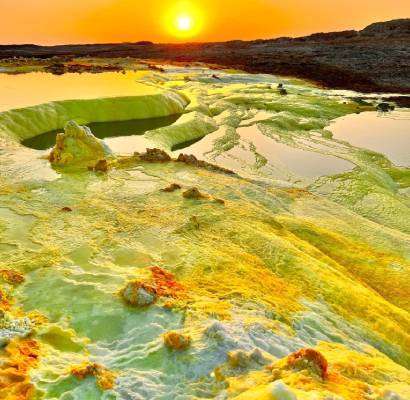
Desert Expedition 6 days Home Overview The Danakil Depression is the northernmost part of the Afar Depression that is also known as the Afar Triangle. The Afar Triangle is a geological depression that sits on what is known as the Afar Triple Junction which is part of the Great Rift Valley. The Afar Triple Junction is at the crossroads of three nations that include Eritrea to the north, Djibouti to the west and, to the south, the entire Afar Region in northern Ethiopia. Within the Danakil Depression are two active volcanoes. Mount Ayalu is the westernmost and older of the two volcanoes. It sits at the southern end of the Danakil Depression. The other active volcano is known as Erta Ale. It is amongst several crater lakes bubbling molten rock from the earth’s core. Within the Danakil Depression is Dallol, which is today the hottest place on earth that is inhabited by human beings. Average temperatures are as high as 35 degrees Celsius. Highlights Itinerary Price included Price not included Reviews Highlights Erta Ale, an active volcano. Dallol, the unique dramatic and colorful geological formations. Lake Asale, where bricks of salt are cut from the lake and loaded onto camel caravans. The hottest and lowest place on the earth. Itinerary Day 01: Addis Ababa After checking the hotel and breakfast, on a sightseeing of Addis, drive up north to Mount Entoto to visit a museum, church and Emperor Menelik Palace. Descending down to Addis, proceed to the Ethnographic museum, which displays a very large collection of Ethiopian crafts and items of historical interest. Continue to visit the Trinity Cathedral, the highest ranking Ethiopian Orthodox Tewahedo cathedral in Addis Ababa, Ethiopia. This was built in 1941 to commemorate the Ethiopian victory over Italian occupation and is an important place of worship in Ethiopia. After lunch, proceed to the National museum that houses the 3.2 million years old fossils of ‘Lucy’ (perhaps our earliest ancestor) is among other interesting archeological findings. Overnight Addis Ababa. Day 02: Addis Ababa – Mekele – Ahmedella (flight) Drive through a small Tigray and Afar villages with spectacular views and amazing rock formation. Lunch stop at Berhaille, Afterwards continue driving to Ahmedella. Late afternoon walking with the camel caravan on their way back from the salt mining field and take pictures. Overnight at Ahemedella, camping. Day 03: Ahmedella – Lake Asale and Dallol Drive to the Salt Lake Asale, and visit the salt workers and the merchant from the highland and proceed to Dallol and enjoy the spectacular view and small hill which is colorful by hot spring in several places. The hot spring out with the sulfurs, potash, and salt it forms spectacular formation. Drive back to Ahmed Ela. Overnight stay, camping. Day 04: Ahmedella – ErtAle Morning, start driving on a rough road to a small village called Kusrawad, to get permission and militias for an access to Ert Ale. The name Erta Ale means ‘Smoking Mountain’ by the local Afar language, it is one of the oldest lava lake in the world, Erta-Ale range is located to the southeast of the summit and is bounded by curvilinear fault scarps on the southeast side. Fresh-looking basaltic lava flows from these fissures have poured into the caldera and locally overflowed its rim. The major recorded eruption was on 1907, and there were other continuous eruptions. To access the summit 3-4hours walk on to the lava field. Overnight, camping at the rim of the mountain. Day 05: Erta Ale – Mekelle Morning walk back to the base and meet the cars to start 6 hours’ drive to Mekelle. Overnight Mekelle. Day 06: Mekelle – Addis Ababa Fly back to Addis Ababa. In the afternoon, visit the Merkato, the largest open-air market in Africa. Enjoy a farewell dinner with traditional Ethiopian cuisine and cultural performances. Overnight Addis Ababa hotel or Departure. Price included Car with fuel Driver allowance Accommodation and Tent for 2 persons Cooking and camping equipment (tents, sleeping mattress) Local guide fee all destinations Sightseeing entrance Scout fee Bottle of water everyday Service fee Price not included Domestic flight Tip Meals Alcoholic Beverages Photo and Videography fee in the villages Sleeping bag (it’s recommended to bring your own) Reviews Book This Tour More Itineraries Ready to Travel With Real Adventure Book This Tour

Scroll to Top