Visit Ethiopia – Sador Ethiopia Tours

Historic North Destinations

Historic North Destinations

Blue Nile Falls

Blue Nile Falls Home Blue Nile Falls Located 35 kms southeast of Bahir Dar, the Blue Nile Fall is a must watch water fall. Local people prefer to call ‘Tis esat’ (water that smokes). It used to cover all the rock above 400 m wide during the rainy season and up to 45 m, it used to drop. Currently, the water fall less because of damming for hydroelectric power station. However, it retains its spectacular fall with the addition of rainbow, riverine forest and surrounding landscape. Blue Nile Fall was visited by the Portuguese traveler Fransico Alvarez in 1520’s and Queen Elizabeth Il of England in 1965. Ready to Travel With Real Adventure Check Availability

Historic North Destinations

Simien Mountains

Semien Mountains Home Semien National Simien Mountains National Park was established in 1969. The park is one of numerous national parks in Ethiopia. The park is located in the northern (Simien) reaches of the Gondar Zone within the Amhara Region. The park’s territory covers the entire Simien Mountains that also include the Ras Dashan, the highest point in Ethiopia. Standing at a height of 4,550 meters, the Ras Dashan is also the 10 highest peak in Africa. Simien Mountains National Park was one of the first sites in Ethiopia to be added to the World Heritage Site list by UNESCO in 1978. Simien Mountains National Park is known as the home to a number of endangered species that include the Ethiopian wolf and the walia ibex. The Ethiopian wolf is native to the Ethiopian Highlands and is very similar to the coyote in terms of build and size. However, the Ethiopian wolf is easily identifiable by its long and narrow skull and sticking red and white fur. Today, the Ethiopian wolf is the world’s rarest canid and is Africa’s most endangered carnivore. The International Union for Conservation of Nature (IUCN) has listed the Ethiopian wolf an endangered species based on its dwindling numbers. There are currently less than 400 Ethiopian wolves in the wild today. The walia ibex is a wild goat found nowhere else in the world other than Ethiopia. The walia ibex is regarded an endangered species and is considered sub-species of the Alpine ibex. Currently, there are less than 500 individuals living in the Simien Mountains. The walia ibex is also known as the Abyssinian ibex. The gelada baboon is by far one of the most famous occupants of the Simien Mountains National Park. Also known as the bleeding-heart baboon, because of its bright pink coloration on its chest, the gelada baboon is a species of what is called the Old World monkey and is only in the Ethiopian high-lands, but a majority of the gelada baboon population is to be seen in the park. Old World monkeys is a group of primates that are native to Africa and Asia mainly inhabiting a range of environments that range from tropical rain forests, to open savanna, shrub lands and mountainous terrain. Ready to Travel With Real Adventure Check Availability

Historic North Destinations

Gheralta

Gheralta Home Gheralta Gheralta, northwest of Mekele, capital of Tigrai Regional State, is the home of a quarter of the rock -hewn churches of Tigrai. Some are famous for their stone workmanship, ancient paintings, and old manuscripts, and others for their magnificent views and difficult ascents. Such great churches as Abune Yemata (Guh), Mariam Korkor, De-breTsion (Abune Abraham), Yohannes Maekuddi, Abune Gebre Michael, and Selassie Degum are in the very heart of Gheralta. The scenery of Gheralta is spectacular. The views of the graceful Mount Gheralta and the far-reaching Hawzien Plain are a rare combination of extraordinary beauty. Gher-alta can now be approached from the town of Wukro 47km north of Mekele along the main highway, from Senkata by traveling 24km north, or by traveling southwest from Adigrat. The important points in the area, AbrahaAtsbaha, Degum, Megab, Mariam Bahra, and Bet YesusGuahgot, are now all connected by a new road, and inaccessibility seems a thing of the past. The main reason to travel to the Gheralta region is its churches. All are hidden in the sides of fantastically shaped mountains. The churches are frequently decorated with beautiful, old paintings, and the often challenging journey is worth the experience it-self. The remote location and the rarified air inside the churches, really leads the mind and senses far away from the hustle and bustle of life. Ready to Travel With Real Adventure Check Availability

Historic North Destinations

Gondar

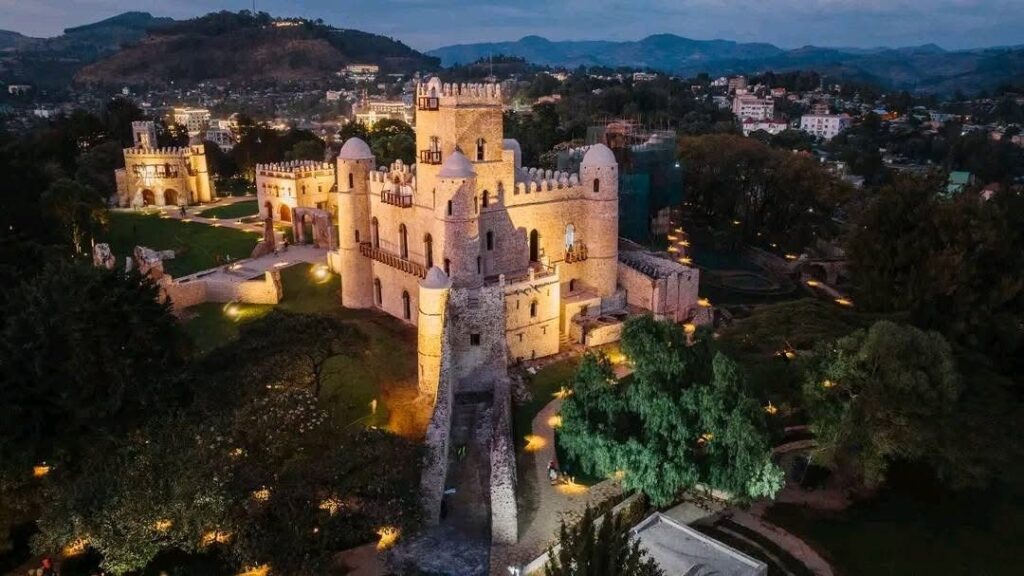
Gondar Home Gondar Gondar… the Camelot of Africa Gondar, which Emperor Fasilidas founded as his capital in 1636, is the site of numerous castle-like palaces, dating from the 17th and 18th centuries. The city was Ethiopia’s capital until the reign of Emperor Tewodros II, also known as Theodore. During the long years when it was a capital the settlement emerged as one of the largest, and most populous, city in the realm. It was a great commercial centre, trading with the rich lands south of the Blue Nile, as well as with Sudan, to the west, inhabitants include many rich Catholic and Muslim merchants, as well as a number of Falashas, or Judaic Ethiopians, also called Bete Israel, who were predominantly weavers, blacksmiths and potters, as well as palace and church builders.   Besides the famous palaces in the royal compound, visitors should inspect the so-called Bathing Palace of Emperor Fasilidas, which is used for the annual Timket or Epiphany, celebrations; the ruins of the Palace, and abbey, of the redoubtable 18th century Empress Mentewab, at Qwesquam, in the mountains just outside Gondar, and just out of the town centre, the church of Debre Berhan Selassie, with its remarkable ceiling decorated with winged angels. Ready to Travel With Real Adventure Check Availability

Historic North Destinations

Axum

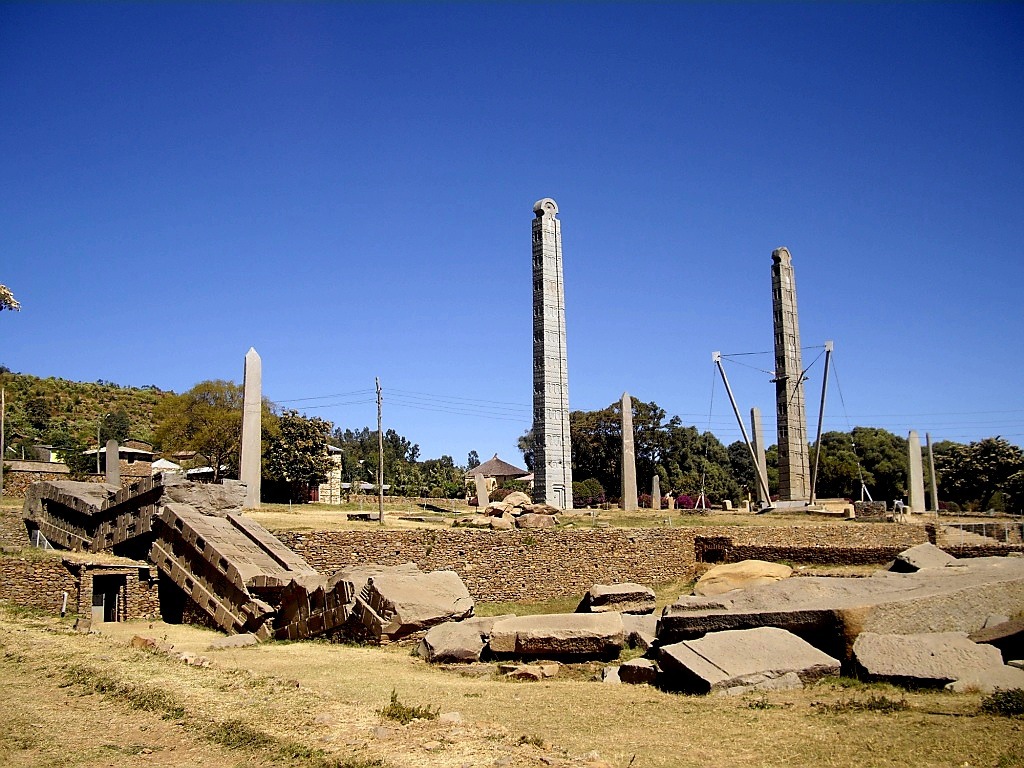
Axum Home Axum Northern Ethiopia’s ancient city of Axum is the country’s oldest extant urban settlement. Once the capital and a major religious center, it remains the site of many remarkable antiquities, including the famous monolithic obelisks, or stelae, important stone inscriptions, the remains of spectacular palaces and graves, and a special gold-silver-and-bronze currency. The city, with its historic church of St. Mary of Tseyon (Zion), is a must for the tourist and any serious student of Ethiopia’s history and culture. Axum grew to importance in classical antiquity – the millennium which included the birth of Christ. The Axumite kingdom emerged as the most powerful Red Sea state between the Eastern Roman Empire and Persia, a great commercial power trading with Egypt, probably Palestine, Arabia, India and Ceylon (now Sri Lanka). The Axumites also had significant trading land contacts with religions to the west and south, some of which were gradually brought into Axum’s economic and later political orbit. After its conversion to Christianity, early in the fourth century, Axum emerged as an important religious centre: the site of the country’s most important and revered Church of St Mary of Tseyon, which, according to Ethiopian tradition, is the repository of the biblical Ark of the Covenant-housed in its own separate building; Axum’s importance survived its political decline, between the seventh and 10th centuries. A number of years later Ethiopian Emperors – all who could do so – went to the city for their coronation. Axum so impressed 19th-century British traveler, Theodore Bent, that he described it at length in his classic travelogue The Sacred City of the Ethiopians. Obelisks/Stelae Much has been written about Axum’s famous monolithic obelisks, or stelae, cut out of the hardest granite, some no more than rudely fashioned stones little larger than a human being, but others massive and beautifully carved monuments which once towered into the sky. The finest represent multi-storey houses, with a ground-floor door, complete with a door handle, and windows on each ‘floor’. In its heyday Axum had three main obelisks. The largest, now fallen and broken into several pieces, is the biggest block of stone ever worked on by humanity anywhere in the world. It was a remarkably impressive piece of workmanship, representing a palace of no less than 12 storey. Many Ethiopians long for the day when it will be erected again on its original site. The second obelisk is some 10 meters shorter, and stands a little away from the great fallen monolith. It was described early in the 1gth century by the British traveller Henry Salt as the most admirable and perfect monument of its kind. Exactly between these two obelisks stood a third monolith, slightly larger than the second, and better carved. This obelisk collapsed and broke into three large pieces. This was taken to Rome, orders given y the Italian fascist dictator Benito Mussolini and erected in 1937 in front of FAO (Food and Agriculture Organization). Nineteenth April 2005 saw the return of this famous Obelisk back to Axum. Ready to Travel With Real Adventure Check Availability

Historic North Destinations

Lalibela

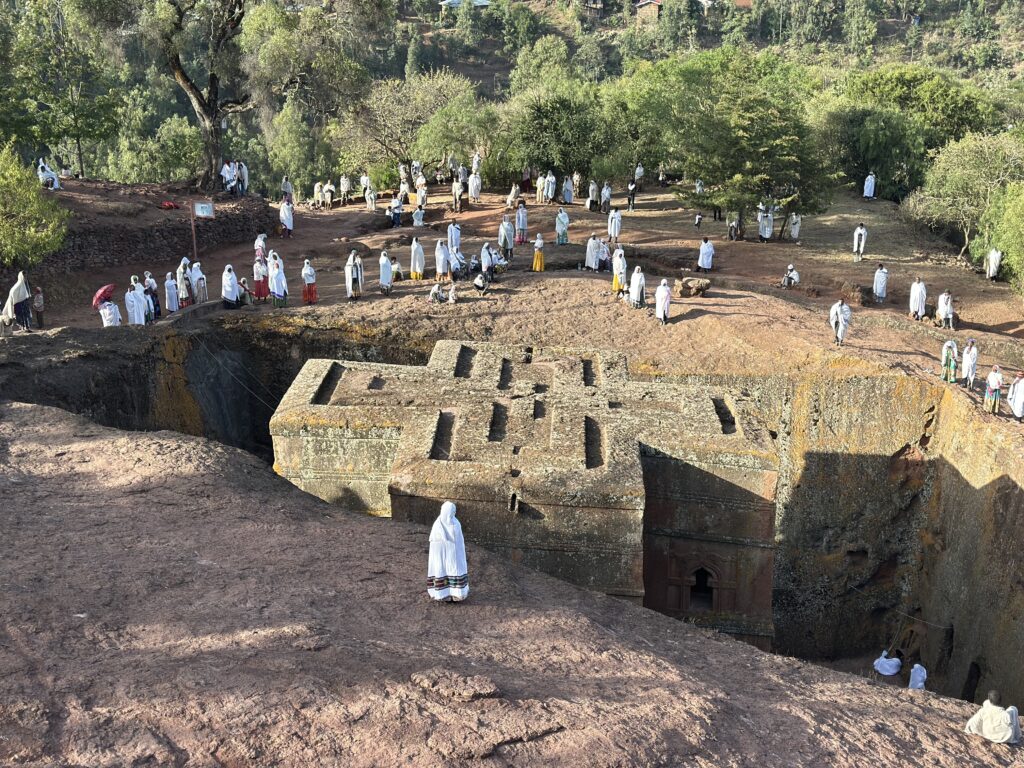
Lalibela Home Lalibela The rock-hewn churches of Lalibela are exceptionally fine examples of a long-established Ethiopian building tradition. Monolithic churches are to be found all over the north and the center of the country. Some of the oldest of such churches are to be found in Tigray, where some are believed to date from around the 6th or 7th centuries. King Lalibela is believed to have commissioned these structures with the purpose of creating a holy and symbolic place which considerably influenced Ethiopian religious beliefs. The 11 medieval monolithic cave churches of this 13th-century ‘New Jerusalem’ are situated in a mountainous region in the heart of Ethiopia near a traditional village with circular-shaped dwellings. Lalibela is a high place of Ethiopian Christianity, still today a place of pilgrimage and devotion. Lalibela is a small town at an altitude of almost 2,800 m in the Ethiopian highlands. It is surrounded by a rocky, dry area. Here in the 13th century devout Christians began hewing out the red volcanic rock to create 13 churches. Four of them were finished as completely free-standing structures, attached to their mother rock only at their bases. The remaining nine range from semi-detached to ones whose facades are the only features that have been ‘liberated’ from the rock. The names of the churches evoke hints of Hebrew, a language related to the Hamo-Semitic dialect still used in Ethiopian church liturgies: Beta Medhane Alem (House of the Saviour of the World), Beta Qedus Mikael (House of St Michael) and Beta Amanuel (House of Emmanuel) are all reminiscent of the Hebrew beth (house). The churches are connected to each other by small passages and tunnels. Ready to Travel With Real Adventure Check Availability

Historic North Destinations

Negash

Negash Home Negash It is found in Tigray regional state located in the northern part of the country, which is 829km away from the capital city Addis Ababa. After reaching Mekeklle capital city of the regional state of Tigray you need to drive about 60 km via Wekro. Negash, 10km after Wukro, lies on a plateau commanding a magnificent view of the surrounding area. Negash got its name from the Tigrinya word (the local language) “Negash or Negasi” meaning king. “Nejashi” is an Arabicized variant of the word. The history of Negash has its origins in the 7th century AD, if not before. Although Negash is as old as the faith of Islam itself, it is this country’s best-unknown place of Islamic worship. History has it that the early followers of the Prophet Mohammed were denied the fundamental right to pursue the religion they preferred and were harshly persecuted by the Quraysh tribe, the mercantile rulers of Mecca. In order to maintain the very survival of his religion, the prophet had to seek a safe hideout for his followers. ” Yonder lieth a country wherein no one is wronged: a land of righteousness. Depart thither, and remain until it pleased the Lord to open your way before you” said the Prophet, pointing to the kingdom of Abyssinia. The ruler of Ethiopia, or Najashi, granted asylum to the first refugees, eleven men and four wives. They arrived in his territory “in the 7th month of the year of Mohammed’s mission (615).” The second “hijira” (flight) consisted of one hundred and one Muslims. Now, Negash is dominated by the “derih” (tomb) of the king and the recently built mosque. Just past the gate of the derih compound, one can see the stone graves of the Muslims who in the early days of Mohammed’s mission had fled their country in pursuit of freedom of worship. Negash is, therefore, not only the burial place of the world’s first Muslim king but also the Allah-Chosen resting place of the bodies of the early Muslims of the world who were denied a home to be buried in because of their beliefs. For these reasons, Negash is considered by many as the second most sacred place of Islamic worship and rightly dubbed by Ethiopian Muslims as “the second Mekkah”. Ready to Travel With Real Adventure Check Availability

Historic North Destinations

Lake Tana

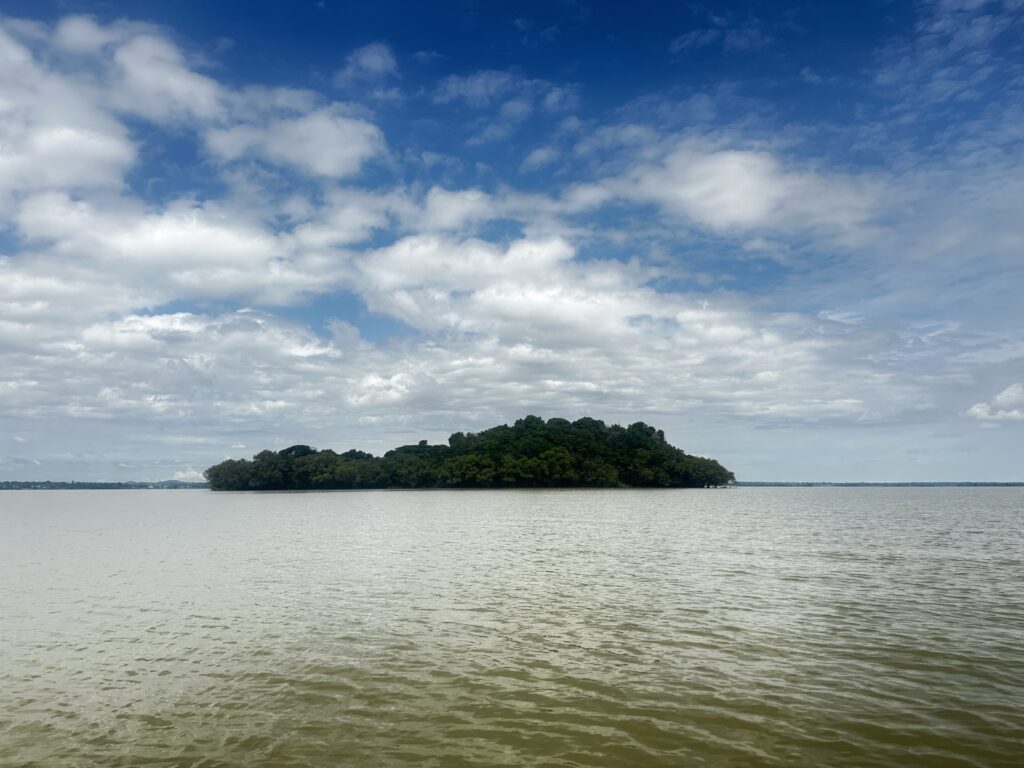
Lake Tana Home Lake Tana Lake Tana is Ethiopia’s biggest lake with a total area of 3,600 square kilometers and a maximum depth of 9 meters. The lake is also the source of the Blue Nile River which drains out of Abay Mench (Abay Spring). But the lake is more famous not only for its size and marine life, but also for its centuries old monasteries as far back as 6th century BC. About 20 monasteries are well kept and functioning in those different islands. The inside of the churches are decorated with the most spectacular colorful wall paintings of stories from the Holy Bible and Ethiopian Saints. The museums in most of these monasteries are packed with rare and oldest manuscript, countless crowns, crosses and even mummified remains of medieval Ethiopian kings. The islands are inhabited by a variety of wetland birds, hippos, crocodile and other animals.   Interestingly, around 70% of the fish species in the lake are endemic. After all it is one of the four UNESCO biosphere reserves in Ethiopia since 2015. The monasteries on the lake are grouped into southern and central monasteries. The monasteries in the southern group, very close to the city; located on the outlet of the Abay River and on Zege peninsula. Debre Maryam, Kibran Gebriel, and the Zege Peninsula monasteries (Azwa Mariam, Entos Eyesus, Bete Mariam, Bete Giorgis and Ura Kidane-Mehret) belong to this cluster.   The central monasteries group is relatively far from the city. As the name indicates, they are located in the far eastern central part of lake. These monasteries in this group consist of Tana Kirkos, the decorated Narga Selassie on Dek Island, the historic Daga Estifanos and many others near to Gondar. Almost all the monasteries have their own museum full of centuries old valuable treasures. Ready to Travel With Real Adventure Check Availability
Scroll to Top